

How to Prioritize Your First 90 Days of Managed IT Improvements in Newport Beach
Once basic IT support is operating, the next challenge is choosing what to improve first. Leadership may hear requests for new computers, stronger access controls, cleaner documentation, better recovery, and application upgrades at the same time.
A useful 90-day improvement plan gives those requests an order. For a Newport Beach business, the aim is not to finish every technical project in one quarter. It is to address the most consequential gaps, remove dependencies, and establish evidence for the next investment decision.
1. Separate improvement planning from onboarding
Onboarding is the transition into an operating support relationship: establishing access, contacts, inventory, and responsibility. This guide begins with a different question: given what the team knows, which improvements deserve limited time and budget?
If basic ownership or access is still unresolved, treat that as a blocking dependency. Do not label a large improvement project ready while its implementation team cannot safely administer the affected system.
Appoint one business sponsor and one technical coordinator. Agree on a review rhythm and the decisions each person can make. Keep the plan small enough that department managers can understand how upcoming changes affect their work.
2. Rank issues by business consequence and evidence
Build a single backlog rather than separate wish lists from every vendor. For each item, record the affected workflow, observed issue, available evidence, proposed action, and consequence of waiting.
Discuss impact, urgency, implementation effort, and dependencies. Avoid false precision: a simple high, medium, or low rating with an explanation can be more useful than a numerical score nobody can defend. Record uncertainty where the team needs investigation before estimating the work.
For example, confirming whether a critical dataset can be restored may deserve attention before refreshing a meeting-room display. That is a prioritization example, not a claim about a particular client’s systems.
Use your Newport Beach managed IT review to agree on the shortlist and explicitly defer lower-priority requests. A deferred item should retain an owner and review date.
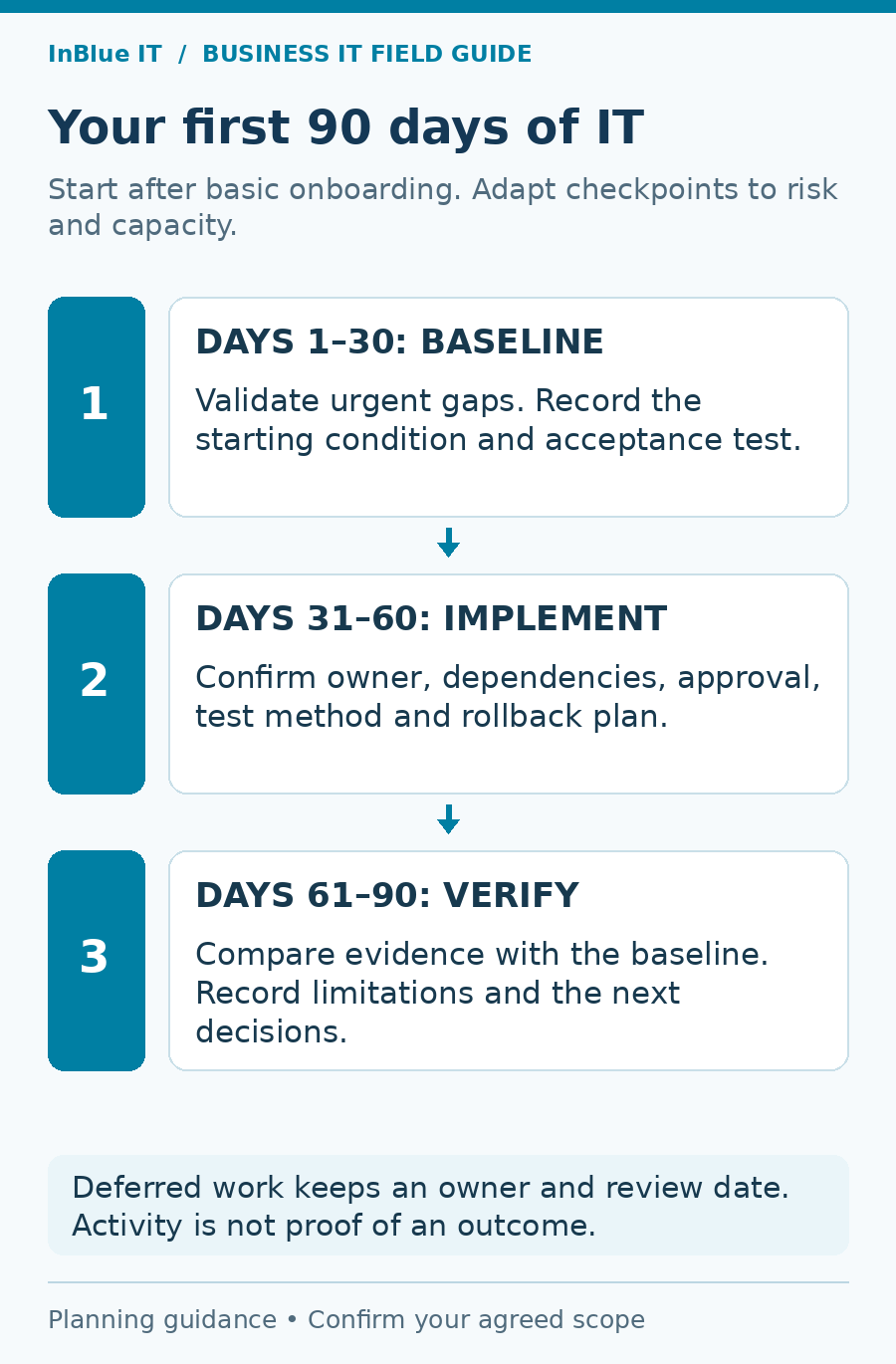
3. Days 1–30: establish the baseline and address urgent gaps
Use the first phase to validate the highest-impact concerns and choose manageable corrective actions. Review the systems supporting essential work, unresolved service interruptions, access ownership, and recovery evidence. Narrow the review to the decisions you need to make rather than collecting documentation without a purpose.
For each selected item, write down the starting condition and acceptance test. If the issue is unclear access ownership, the evidence of progress may be an approved owner list and completed access review. If recovery is the concern, define the specific data or workflow to test.
Discuss security priorities with the team responsible for cybersecurity in Newport Beach. Distinguish an urgent containment decision from a longer improvement project so critical work does not wait for a quarterly meeting.
4. Days 31–60: fix dependencies and recurring friction
Move approved work into an implementation queue with realistic capacity. Before scheduling a change, confirm its owner, prerequisites, business approval, test method, and rollback plan.
Look for dependencies that unlock several improvements. Clear account ownership, a reliable device inventory, or a documented application support route may make later projects easier to execute. Choose them because they support named outcomes, not because they make a dashboard look complete.
Include department representatives in testing. A technically successful change still needs a check that employees can complete the intended task. Record problems discovered during the test and keep the item open until its acceptance criteria are met or leadership explicitly accepts the limitation.
5. Days 61–90: verify outcomes and choose the next quarter
Compare completed work with the original baseline. Separate actions performed from outcomes demonstrated. Installing a tool is an activity; showing that the intended process now works requires its own evidence.
Review recurring issues over an agreed observation period and identify anything still uncertain. Mark unfinished work honestly. Do not convert an expected benefit into a reported saving without a defensible measurement.
Close the quarter with a short checklist:
- Evidence: attach the acceptance test or review record for each completed priority.
- Ownership: name who maintains the improved process after project work ends.
- Exceptions: document remaining limitations and their business approvers.
- Capacity: compare actual implementation effort with what the team can sustain.
- Next decisions: identify approvals and dependencies for the next quarter.
- Backlog: revisit deferred items rather than allowing them to disappear.
The deliverable is a better-supported set of decisions, not a declaration that every risk has been eliminated. Keep the next plan focused on what the business can realistically implement and maintain.
Frequently asked questions
Should every business follow the same 30-day phases?
No. Use the phases as planning checkpoints. An urgent incident, seasonal workload, or vendor dependency may change the sequence. Document the reason rather than forcing work into arbitrary dates.
What if the budget cannot cover the highest-priority project?
Ask for a smaller interim action, the limitations it leaves, and the decision deadline. Have leadership explicitly accept or reject the remaining risk rather than quietly substituting a cosmetic improvement.
How do we know the quarter was successful?
Check whether agreed priorities met their acceptance criteria, unresolved issues have owners, and leadership has better evidence for the next decision. Judge the plan against approved goals, not a generic promise of transformation.
Turn your improvement backlog into a practical sequence. Book Free Assessment with InBlue IT Solutions or call (888) 999-8821.